
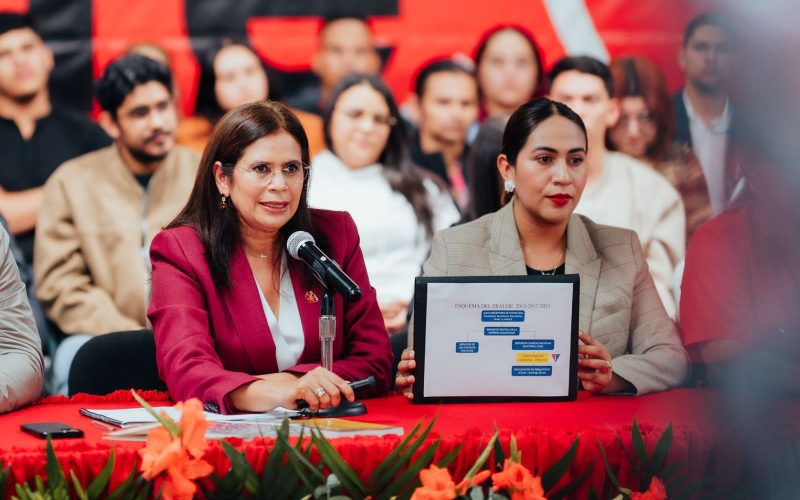
Cinco meses antes de las elecciones generales el 30 de noviembre, el partido gobernante Libertad y Refundación (LIBRE) se encuentra en una coyuntura crítica, caracterizada por divisiones internas, acusaciones de corrupción y un notable descenso en las intenciones de voto. En un escenario electoral cada vez más incierto, el desgaste acumulado del partido en el poder pone en peligro la continuidad de su mandato.
Internal fractures and loss of cohesion
The selection of Rixi Moncada as the ruling party’s candidate exposed tensions that had been building within LIBRE. The subsequent resignation of Congressman Jorge Cálix, a long-time member of the organization, revealed deep disagreements over the party’s political direction and leadership style. Cálix, along with other leaders who also left the party, denounced authoritarian practices and a culture of exclusion.
In response, the party leadership called for demonstrations in support of both President Xiomara Castro and Moncada herself. However, these actions failed to reverse the perception of a weakened organization and have been interpreted by various sectors as attempts to retain political control in the midst of an adverse environment.
Corruption scandals and questions about transparency
The situation deteriorated further after the disclosure of supposed irregularities within the Secretariat of Social Development (SEDESOL), where deputies linked to the governing party faced accusations of misappropriating funds intended for social programs. The most notable instance involved Congresswoman Isis Cuéllar, whose suspension was declared alongside the termination of social funds and an extraordinary step: the party collectively renouncing legislative immunity.
Although these decisions seem to be quite decisive, opposition parties, particularly the National Party, have labeled them as gestures meant to distract the public. As per their representatives, the measures taken by the ruling party lack real consequences or thorough investigations to impose responsibility.
Private sector discontent and calls to halt institutional deterioration
Los comentarios críticos no se han restringido solo al ámbito político. Figuras destacadas en el sector empresarial han mostrado su inquietud acerca del rumbo del país. En una declaración hecha recientemente, Eduardo Facussé, quien anteriormente lideró la Cámara de Comercio e Industria de Cortés (CCIC), acusó directamente al gobierno de traicionar el mandato popular mediante prácticas que, según sus palabras, incluyen nepotismo, uso discrecional de fondos públicos, y falta de transparencia en casos emblemáticos como SEDESOL, el fraude de Koriun y las acusaciones de vínculos con redes criminales.
Facussé cautioned about the deterioration of institutions and urged the public to protect the rule of law against what he viewed as an effort to establish an authoritarian and financially unviable system.
Decline in survey results and reshaping of the voting landscape
The most recent opinion polls reflect a rapid decline in LIBRE’s voting intentions. According to data collected between May and June, support for the ruling party has ranged between 11% and 28.5%, well below the 42% recorded in March. This downward trend, coupled with volatility between polls, suggests a fragmented electoral base in search of alternatives.
Simultaneously, rival candidates like Salvador Nasralla and Nasry Asfura have made headway, achieving backing levels between 25% and 36%. Public approval also reflects the declining image of the government: President Xiomara Castro has an average score of merely 4.1 out of 10, amidst an environment characterized by ongoing scandals and an increasing sense of ineffectiveness.
A doubtful future for the governing party
The current situation presents LIBRE with a major challenge. The combination of internal crises, institutional deterioration, loss of credibility, and citizen rejection has weakened its position ahead of the general elections. If this trajectory continues, the ruling party risks not only losing control of the executive branch but also seeing the political project that brought it to power in 2021 compromised.
In this scenario, the outcome will depend on the party’s ability to rebuild its internal structure, address social demands, and offer clear responses to allegations of corruption. Otherwise, the November 30 election could mark a turning point in Honduran politics.